 EN
EN
 AR
AR

5-Tooth Drill Bit Length Size Chart (5-Button Tapered Bit Specifications)
Selecting the correct bit size is critical for maximizing penetration rates and tool life. This 5-tooth drill bit length size chart provides technical specifications for tapered button bits used in mining and quarrying. These bits are designed to match standard tapered drill rods with 7°, 11°, and 12° tapers.
Detailed 11° Tapered 5-Tooth Drill Bit Size Chart
| Diameter (mm) | Diameter (inch) | Taper Degree | Button Layout | Weight (kg) |
|---|---|---|---|---|
| 32 mm | 1 1/4" | 11° | 5-Button (2 Front / 3 Gauge) | 0.24 kg |
| 34 mm | 1 11/32" | 11° | 5-Button (2 Front / 3 Gauge) | 0.29 kg |
| 36 mm | 1 27/64" | 11° | 5-Button (2 Front / 3 Gauge) | 0.36 kg |
| 38 mm | 1 1/2" | 11° | 5-Button (2 Front / 3 Gauge) | 0.39 kg |
| 40 mm | 1 37/64" | 11° | 5-Button (2 Front / 3 Gauge) | 0.40 kg |
| 41 mm | 1 5/8" | 11° | 5-Button (2 Front / 3 Gauge) | 0.41 kg |
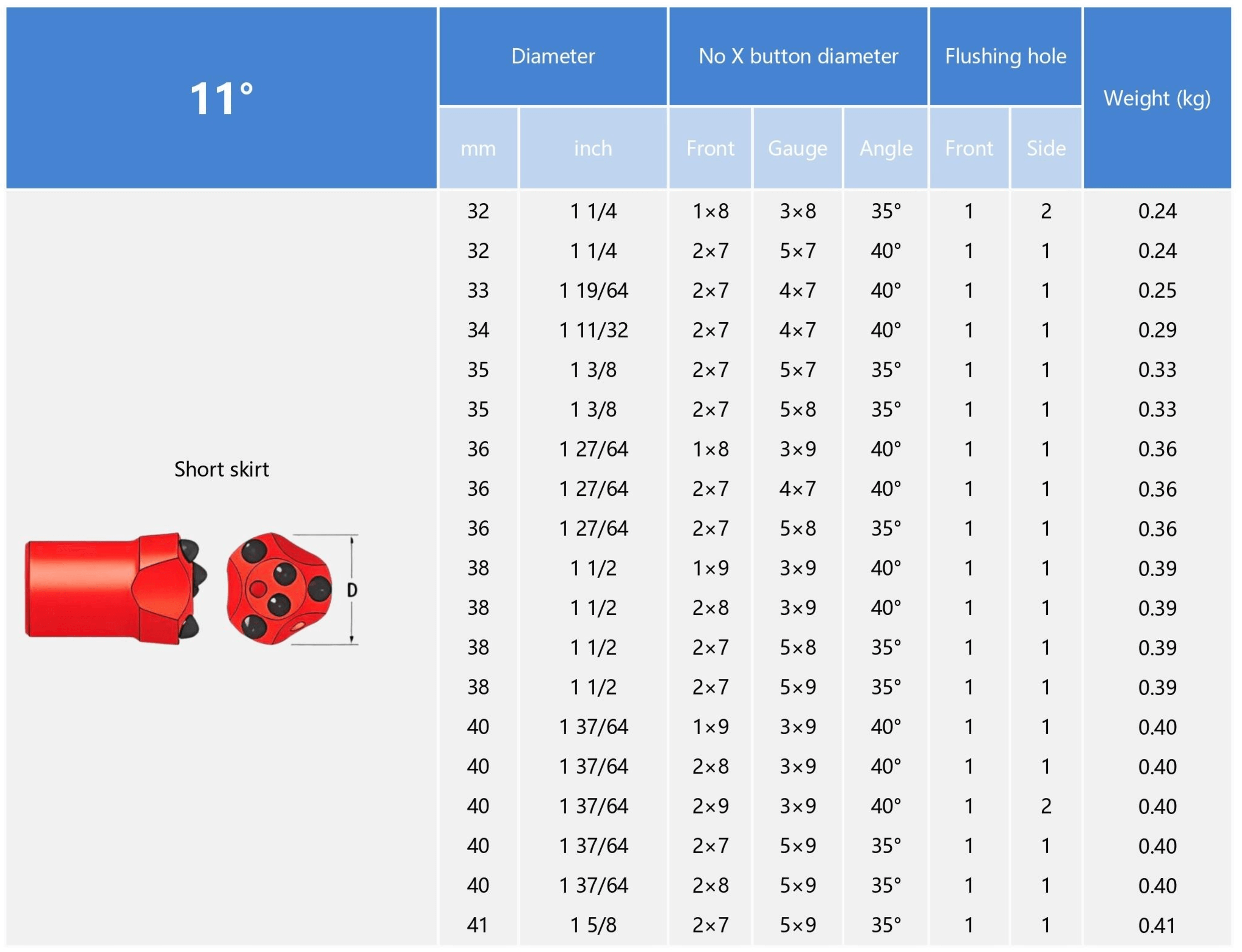
Visual Reference: Expandag 5-Tooth Tapered Button Bit Size Chart.
How to Select the Correct Size
When using handheld rock drills like the YT28 or YN27C, bit diameter selection must balance speed and hole clearance. A 32mm bit provides the fastest penetration, while 38mm-42mm bits are ideal for placing larger volumes of expansive mortar. Ensure your tapered rod degree matches the bit precisely to avoid premature shank failure.
RECOMMENDED: EXPANSIVE MORTAR | ROCK DRILLS MACHINE | DRILLING TOOLS
5-Tooth Tapered Drill Bit FAQs & Selection Guide
Q1: What are the most common sizes in a 5-tooth drill bit chart?
A: As shown in our technical chart, the most widely used diameters for 5-button (5-tooth) tapered bits range from 32mm to 42mm (1 1/4" to 1 37/64"). These sizes are optimized for high-speed penetration in medium-hard rock formations.
Q2: Why choose a 5-button bit over a 7-button or 8-button bit?
A: The 5-button configuration offers larger gaps between the tungsten carbide tips, which allows for superior flushing (debris removal). This makes it the specialist for fast penetration in softer or less abrasive rock, where bits with more buttons might clog or re-grind dust.
Q3: How do I match the taper degree (7°, 11°, or 12°) to my drill rod?
A: It is critical for the bit taper to match the rod taper exactly. Standard 7-degree bits are typically used with lighter handheld rock drills (Y24), while 11-degree and 12-degree bits are engineered for high-impact pneumatic air-leg drills (YT28/YT29A) to ensure a secure, anti-slip connection.
Q4: What is the drilling speed of a 5-tooth bit in hard granite?
A: When paired with an Expandag YT28 rock drill at 0.5 MPa pressure, a 36mm 5-tooth bit can achieve a penetration rate of 250mm to 400mm per minute, depending on the rock's precise hardness (f-scale).
Q5: Which bit diameter is best for using Expansive Mortar (HSCA)?
A: For optimal rock splitting results, we recommend a borehole diameter between 38mm and 42mm. This provides the ideal volume for the expansive mortar to generate peak chemical pressure (120 MPa) without causing excessive material blow-outs.
Q6: How can I extend the service life of my tapered button bits?
A: To maximize lifespan, avoid "dry drilling" and ensure consistent air pressure. Most importantly, re-sharpen the carbide buttons using a diamond grinding cup once they develop a flat wear surface. Timely maintenance can prevent button pop-outs and catastrophic bit failure.
